
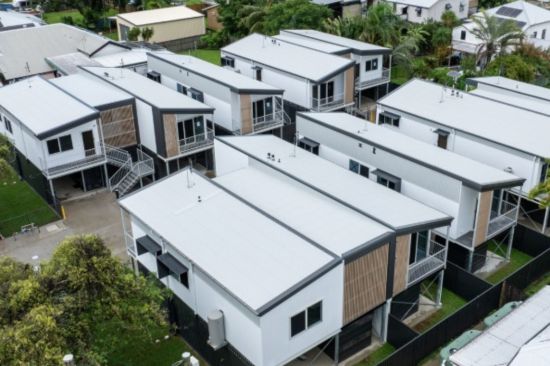
As part of Queensland’s Modern Methods of Construction (MMC) program, QBuild has delivered a series of modular homes designed to meet housing needs in regional and remote communities. Each dwelling — ranging from one to four bedrooms — was constructed in a controlled factory environment before being transported and installed on site.
The approach combines volumetric modules, flat-pack systems, and kit-of-parts assemblies to achieve precision workmanship and consistent quality outcomes. While site works such as foundations and services were underway, the dwellings were simultaneously fabricated in Rapid Accommodation and Apprenticeship Centres (RAACs), allowing both streams to progress in parallel. This significantly reduced overall delivery time compared with conventional construction approaches.
Once completed, modules were transported by truck, craned into position, and connected with minimal on-site disruption. The homes were designed for durability, accessibility, comfort and long-term community benefit. Centralising construction in RAACs also reduced waste and supported skills development by enabling apprentices and tradespeople to gain experience in emerging construction technologies.
The Challenges
Combining different fire rating systems
Modular housing incorporates prefabricated components from different suppliers, each with its own testing methods and fire resistance ratings. Integrating these systems can create uncertainty around how the total assembly will perform in practice.
Fixing details
Modules are joined on site, creating a series of junctions and interfaces that must maintain fire separation. These connection points are often more complex than in traditional builds and can become weak points without considered detailing.
Service penetrations
Mechanical, electrical, and hydraulic services must run between modules, requiring multiple penetrations through fire-rated walls and floors. Each penetration must be sealed with compliant systems to preserve the required fire resistance levels.
Occupant evacuation
The compact layouts of modular and social housing can limit corridor widths and stair placement. Demonstrating safe evacuation pathways within these tighter spatial constraints is a critical consideration.
Bloom’s Impact
Integrated fire rating strategies
Bloom reviewed the performance of prefabricated elements and developed strategies to harmonise fire resistance systems. This ensured the building would operate as a coordinated, compliant whole.
Resolved fixing details
Through detailed assessment and documentation, Bloom delivered compliant solutions for joints and connections between modules. This gave certainty that fire separation was maintained without compromising constructability.
Protected service penetrations
Bloom identified compliant systems for sealing penetrations and provided guidance on correct installation methods — reducing the risk of non-compliant outcomes during construction.
Optimised evacuation design
By analysing occupant movement and egress capacity, Bloom demonstrated that safe evacuation could be achieved within modular layouts. This addressed regulatory requirements while maintaining efficient, flexible design options for QBuild.
© 2023 Bloom Fire Consulting
ABN: 69 642 845 252